The European Approach to Protecting Your Data

Almost four years ago, the highest court in the European Union (EU)1 ruled that citizens of member countries had a “right to be forgotten”. Of course, that ruling left some holes and more than a few questions. But it did trigger some increasingly public conversations around the general topic of privacy and personal data.

That discussion, paired with some massive data breeches at high profile companies, led the EU Parliament to create a new set of laws2 dealing with data security and privacy. Those rules, the General Data Protection Regulations (GDPR), will become effective in the EU beginning in May.

In general, the GDPR sets strict guidelines for the kind of data that can be collected from individuals by companies and organizations, and how that data can be used. That data includes anything that can be used to specifically identify a person (including social media posts, location info, photographs, etc.), as well as not so obviously personal information like race, religion, and politics.

GDPR also requires companies to obtain more specific consent from the user as well as explaining more clearly how their data will be used. Specifically excluded is vague language like “Improving users’ experience”, “marketing purposes”, or “future research”. Companies must also make it easy for users to withdraw their consent and are then required to delete the material they’ve collected. 

So what has any of this got to do with those of us not living in Europe? Plenty.

While the regulations are specific to the member countries of the EU, most of what I’ve read about them suggest that all of us in the US, and elsewhere in the world, will likely be affected by them.

The law applies to any company or organization that does business in the EU member countries and collects personal data from their citizens. That includes many based in the US, familiar names like Facebook, Google, Microsoft, Apple, and more. Since most multinational corporations shuffle information around the world, it’s very likely that they will need to adapt their data handling practices everywhere, not just in Europe.

Plus the law also also provides for some pretty hefty penalties for misusing or failure to secure the data, including fines of up to €20 million or 4% of “global turnover”, whichever is larger. To put that in some perspective €20m (about $24m US at the moment) is pocket change for Facebook. 4% of their total income is not.

I know, all of this is pretty geeky stuff.

However, it’s also important if you’re concerned about the data most companies are already collecting about you and others. If you’re interested in more details of the GDPR in basic, non-legal language, check out this rough guide to GDPR and/or this short summary directed at US corporations.

Of course, the EU laws are not perfect. There will likely be much confusion when they take effect, and when the first law suits follow not long after. It will be interesting to see whether the big data collectors will be forced to change their behavior. Or will they just find new ways to continue their current practices? After all, our information is the foundation of their massive profits.

Beyond that, there’s also the larger question of whether the US should implement similar laws? It’s not likely to happen in this political climate, with political “leaders” who claim that the “free market” will protect us all. But maybe some outside pressure on US-based companies may effect some need change.


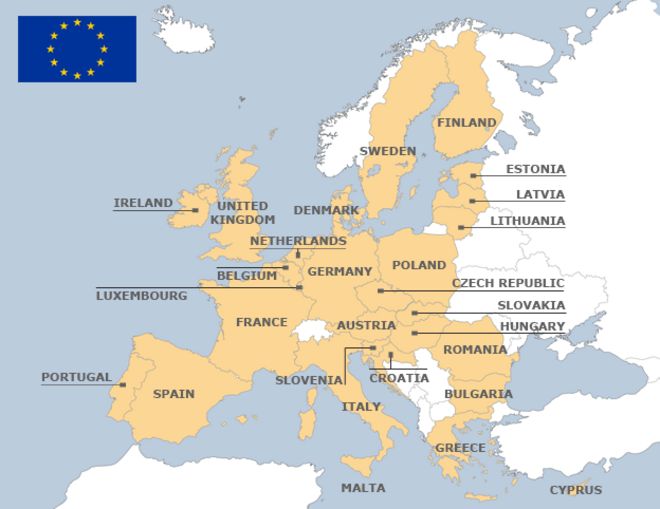
The map is from the BBC, showing the current configuration of the European Union. Of course, their home country, the United Kingdom, is in the process of a very contentious “Brexit” from the EU, so that map could change in 2019. In more than one way if the people of Scotland and Northern Ireland make some hard decisions.

1. Very tangential side note: I love that the official anthem of the EU is based on Beethoven’s “Ode to Joy”. Certainly more uplifting music than the militaristic tones of most national anthems.

2. In some of what I’ve read, experts says that GDPR isn’t so much “new” law as it is a clarification of many different data and privacy regulations that are already on the books, combined with court rulings. Either way, GDPR is likely going to change the way companies do business in the EU, and possibly elsewhere.

The Surveillance Classroom

During the 2016 holiday season, Amazon’s Alexa devices were huge sellers. Google was second in the category with Home. Apple just started shipping their Siri-enabled Homepod and they will probably sell a bunch of them.

So now tens of millions of homes have always-listening internet-connected microphones listening to every sound, and more are coming. This despite the many cautions from privacy experts about allowing large corporations to have access to a new continuous stream of auditory data. 

But who cares if the artificially intelligent software powering these devices is buggy? Does it matter that Amazon, Google, and Apple are vague about how they are using that information and who has access to it? Let’s bring these boxes into the classroom!

Michael Horn, co-author of Disrupting Class, the hot education-change book from a decade ago, says Alexa and her friends is “the next technology that could disrupt the classroom”.

It’s not entirely clear why Horn believes a “voice-activated” classroom would improve student learning. Other than that the superintendent he has interviewed is concerned that kids “will come in and will be used to voice-activated environments and technology-based learning programs”.

That’s nothing new. For a few decades (at least) we have been throwing technology into the classroom based on the premise that kids have the stuff at home. That approach hasn’t been especially successful, and Alexa is not likely to change that.

But these days, a major reason for using many, if not most, new classroom technologies is collecting and analyzing data.

These devices could also send teachers real-time data to help them know where and how they should intervene with individual students. Eastwood imagines that over time these technologies would also know the different students based on their reading levels, numeracy, background knowledge, and other areas, such that it could provide access to the appropriate OER content to support that specific child in continuing her learning.

Maybe I’m wrong but I think it’s better to have a teacher or other adult listening to kids.

Anyway, Horn presents a lot of questions about the use of Alexa and her peers in the classroom but his last one is probably the most salient: “What is the best use of big data and artificial intelligence in education?” Before ending, he also very briefly touches on the security of that data – “And there are bound to be privacy concerns.”. As I said, briefly.

But the bottom line to all this is whether we want Amazon, Google, or Apple surveillance devices collecting data on everything that happens in the classroom. Horn seems to think the technology could be disruptive. It sounds creepy and rather invasive to me.


The image is from an article about a contest Amazon is running for developers, with cash prizes for the best Alexa apps that are “educational, fun, engaging or all of the above for kids under the age of 13”.

Go Ahead, I’m Listening…

During the holiday season, connected devices containing voice-activated assistants from Amazon (Alexa) and Google were among the most popular gifts. This week at the giant Consumer Electronics Show (CES), lots of companies demonstrated many more future products infused with Alexa, Google, and Apple’s Siri. Including “smart” shower hardware.

But, according to the ACLU blog, you may want to think twice about placing an always-on, internet connected microphone in your home.

Overall, digital assistants and other IoT devices create a triple threat to privacy: from government, corporations, and hackers.

It is a significant thing to allow a live microphone in your private space (just as it is to allow them in our public spaces). Once the hardware is in place, and receiving electricity, and connected to the Internet, then you’re reduced to placing your trust in the hands of two things that unfortunately are less than reliable these days: 1) software, and 2) policy.

The constant potential for accidental recording means that users do not necessarily have complete control over what audio gets transmitted to the cloud.

Once their audio is recorded and transmitted to a company, users depend for their privacy on good policies—how it is analyzed; how long and by whom it is stored, and in what form; how it is secured; who else it may be shared with; and any other purposes it may be used for. This includes corporate policies (caveat emptor), but also our nation’s laws and Constitution.

Lots of pieces, technical and legal, that all have to work together to protect your information and privacy. I’m not convinced we’re there yet.

Heading off on an only slight detour, this issue of artificially intelligent assistants is something all of us educators need to watch. I’ve read of a few teachers who have placed Alexa and Google Home devices in their classrooms, although I’m not at all clear on the instructional purpose.

However, beyond that, many edtech companies are already building some form of data-collecting AI into their products. I fully expect to see always-listening, education-related devices being pitched to schools in the very near future, very likely with many of the same issues raised in this article.

Smile For The Data Collector

If you’ve ever used Google’s mapping products, at some point you’ve probably dropped into Street View. This year marks ten years since those 360° street level images were first released, and since then, the company has “snapped more than 80 billion photos in thousands of cities and 85 countries”.

Wired reports that Google has now begun deploying their next generation Street View rigs, featuring cameras with much higher resolution. But their ultimate goal is not just offering a better look at your next vacation destination.

[The cameras are] there to feed clearer, closer shots of buildings and street signs into Google’s image recognition algorithms.

Those algorithms can pore over millions of signs and storefronts without getting tired. By hoovering up vast amounts of information visible on the world’s streets—signs, business names, perhaps even opening hours posted in the window of your corner deli—Google hopes to improve its already formidable digital mapping database. The company, built on the back of algorithms that indexed the web, is using the same strategy on the real world.

The detailed analysis of signs in store windows, however, is just the beginning of what Google and others will be able to do with this visual data.

How much more could Google extract from Street View using image processing algorithms? A lot.

Earlier this year Stanford researchers, including professor Fei-Fei Li, now chief scientist at Google’s cloud division, showed they could predict income, race, and voting patterns for US cities with software that logs the make, model, and year of cars in Street View photos.

Ok, that’s a little creepy.

Anyway, on this tenth anniversary of Street View, there’s really not much that can be done about taking pictures in public. Everyone has a camera and cameras are everywhere, not just in cars from huge data collection companies. And, as a photographer (strictly amateur), I believe in minimal restrictions when it comes to photography.

When those millions (billions?) of discrete pictures are turned into massive data sets and processed by complex, invisible algorithms, it’s another story. A story that is very much still been written.

Beware the Algorithm

Cathy O’Neil is the author of a great book with the wonderfully provocative title, Weapons of Math Destruction. But it’s not hyperbole. In it she clearly and compellingly explains how algorithms, fueled by big data, are being used everyday to make decisions about important points in our lives. This includes whether or not we qualify for a loan, get a job, or go to prison.

Or create the “value add” rating a teacher receives, the one that mixes student test scores with data other points to determine if they keep their job.

The companies who sell those evaluation systems want us to believe that their mathematics is completely objective and a neutral judge of people. O’Neil, however, presents a variety of examples, starting with the teacher evaluation programs sold by Pearson and others, to explain why that’s just not true. She explains how the data used to build the algorithms usually comes with biases based on how and why it was collected. And additional bias is built into the systems by the people who ultimately decide what the resulting numbers mean.

While I highly recommend reading the book, you can get the TL;DR version of O’Neil’s warning in her TED talk from last spring, recently posted to their site and embedded below.