School Is Hearing You

Schools, and many other businesses, are concerned with the possibility of violence in their buildings, justifiably in many areas. So, administrators are looking for new technologies that would allow them to spot trouble before it happens. Technologies that include AI-enhanced video and audio surveillance.

A new report from the non-profit investigative journalism organization ProPublica1 says that there are many companies are only too happy to sell them systems which, they claim, can detect an incident in the making.

By deploying surveillance technology in public spaces like hallways and cafeterias, device makers and school officials hope to anticipate and prevent everything from mass shootings to underage smoking. Sound Intelligence also markets add-on packages to recognize the sounds of gunshots, car alarms and broken glass, while Hauppauge, New York-based Soter Technologies develops sensors that determine if students are vaping in the school bathroom. The Lockport school district in upstate New York is planning a facial-recognition system to identify intruders on campus.

The various systems rely on algorithms to sort out the various sounds and alert administrators when something matches particular patterns stored in the database. However, at least one system analyzed by ProPublica produced many false positives, while also recording and storing the audio collected by its microphones.

Yet ProPublica’s analysis, as well as the experiences of some U.S. schools and hospitals that have used Sound Intelligence’s aggression detector, suggest that it can be less than reliable. At the heart of the device is what the company calls a machine learning algorithm. Our research found that it tends to equate aggression with rough, strained noises in a relatively high pitch, like D’Anna’s [a student who worked with the reporters] coughing. A 1994 YouTube clip of abrasive-sounding comedian Gilbert Gottfried (“Is it hot in here or am I crazy?”) set off the detector, which analyzes sound but doesn’t take words or meaning into account. Although a Louroe spokesman said the detector doesn’t intrude on student privacy because it only captures sound patterns deemed aggressive, its microphones allow administrators to record, replay and store those snippets of conversation indefinitely.

As you might expect, surveillance technologies like this can often side effects, especially when used with young people in schools.

Dr. Nancy Rappaport, an associate professor of psychiatry at Harvard Medical School who studies school safety, said the audio surveillance could have the unintended consequence of increasing student distrust and alienation. She added that schools are opting for inexpensive technological fixes over solutions that get to the root of the problem, such as more counseling for troubled kids. One Louroe microphone with aggression software sells for about $1,000.

Covering a school with microphones to spy on the kids is far cheaper than hiring qualified counselors who will actually interact with them.

Anyway, then there is the problem inherent with any kind of artificial intelligence: the underlying code that analyzes the data collected is written by human beings, and far too often incorporates their biases.

Researchers have also found that implementing algorithms in the real world can go astray because of incomplete or biased training data or incorrect framing of the problem. For example, an algorithm used to predict criminal recidivism made errors that disproportionately punished black defendants.2

There is much more detail in the the full report, including an explanation of how they tested the devices they purchased, along with audio and video of the students they enlisted to help. The whole thing is worth your time, especially if you teach in a school district that might be considering surveillance systems of any kind.

But I also wonder what students might think about this issue. About the idea of school administrators collecting and storing the sounds of their daily life. This report might make a wonderful jumping off point for discussion and further investigation in their community.


The image is one of the Sound Intelligence microphones purchased by ProPublica. It is intended to be installed on the ceiling, and the fact that it resembles a common smoke detector is probably not a coincidence.

1. For their wide-ranging investigations and reporting, ProPublica is well worth your financial support.

2. For much more about the problems with allowing algorithms to make decisions concerning people, I highly recommend the book “Weapons of Math Destruction” by Cathy O’Neil

No, Google Is Not Free

One of the 800-pound gorillas at ISTE, of course, is Google. They are “gold” sponsors (meaning they kicked in more money than the silver and bronze level companies) and have a huge presence on the vendor floor, both in their own booths and in the booths of dozens (hundreds?) of other companies that connect to them in some way. Plus many, many sessions and posters deal with their various education-related products.

And one term commonly associated with all of this Googley goodness is free. Educators love free, and they don’t pay to use GSuite, Classroom, Expeditions, Maps, Earth, ChromeOS, Photos, storage, and, of course, Search.

Except these services really are not free.

Instead of sending Google money, education users and their students, like the rest of us, are contributing labor and data to the company. In Google’s own words:

The Google Privacy Policy describes fully how Google services generally use information, including for G Suite for Education users. To summarize, we use the information we collect from all of our services to provide, maintain, protect and improve them, to develop new ones, and to protect Google and our users. We also use this information to offer users tailored content, such as more relevant search results. We may combine personal information from one service with information, including personal information, from other Google services. [emphasis mine]

Another way to look at our relationship with Google comes from an essay in Slate about another free product that’s been in the news lately, Facebook.

There are at least two alternative ways of viewing our relationship to Facebook… The first is to view ourselves as customers of Facebook, paying with our time, attention, and data instead of with money. This implies greater responsibility on both sides.

The second is to view ourselves as part of Facebook’s labor force. Just as bees labor unwittingly on beekeepers’ behalf, our posts and status updates continually enrich Facebook.

Swap Google for Facebook in those statements. We help their marketing department by putting their name and products in front of students, often for many hours a day. We also provide the labor to help develop and test products that will make them a lot of money.

And do not assume students are protected by working in a “closed” Google Education environment. Unless your network never connects to the outside world, there are many ways for Google (and others) to connect your “anonymous” students to advertisers, now and in the future.

Anyway, even with all that, I’m not trying to convince you to quit using Google’s products, either personally or in the classroom. I use some of them myself (although not as much as I used to). I even present conference sessions and workshops encouraging teachers to use Google Earth and Google’s other geo-related resources for their instruction.

However, everyone needs to understand that the cost of “free” admission to Google (or any other services that don’t charge at the door) is your data. Data that is stored, analyzed, connected with other data, and occasionally sold, stolen, or otherwise distributed to third parties. With your permission, since you agreed to the terms of service you probably didn’t read when registering for that first Gmail address.

So, by all means, continue using Google and other free services. But, in the wise words of Sgt. Phil Esterhaus, let’s be careful out there.


If you’ve never seen the classic cop show Hill Street Blues, you’ve missed some good TV. At least for the first three or so seasons. I think it’s available on Hulu and maybe other streaming services.

Digging Into My Facebook Data

Piles of Books

Facebook has been in the spotlight lately, over a variety of issues related to how they collect and use the data of their “members”. Which means they’re doing a lot of apologizing and tinkering with their system, hoping to avoid more negative publicity and political interference.

But even without the recent problems, Facebook would be making alterations to their data policies, because of new laws in the European Union that go into effect next month. Among other features, the General Data Protection Regulations (GDPR) will give citizens of the EU the right to see the data companies have collected on them.

Which is probably one reason why Facebook is now offering a way to download a copy of the information they have on you. You’ll find a link to make the request under General Account Settings.

If you’re an active Facebook user, be prepared for a large file. They will be sending your entire timeline, all the messages you’ve sent and received, every photo and video you’ve uploaded, and more.

My file, however, was not large at all, a zipped file of 74kb.

Although I registered for a Facebook account ten years ago, I’ve never posted anything in that time1 and very rarely comment on the posts of others. The only reasons I open the app a few times a month are to see the latest photos from friends and relatives, and to read new comics from Bloom County. I’m just not very social I guess.

In fact, the only even slightly interesting part of my Facebook data is in the Ads section, where we find a list of advertisers with my contact info. First advertiser: Cyndi Lauper. Farther down is Rod Stewart. Very odd.

The rest of the list includes a few companies I use regularly or from whom I’ve requested information. And many sites dealing with crowdfunding I’ve never heard of. I’m very sure I did not click on any ads for these firms in Facebook or on articles related to them.

All of which leads to a basic question: why did Facebook send my information to those advertisers? What did their algorithms find in my bland profile and very sparse timeline that lead to those matches? I suspect some of this data came from the harvesting Facebook does on other websites.

Anyway, check out the data Facebook has stored in your account. You may find something even more interesting.


The image is piles of old fashioned data taken by Michael Coghlan, posted to his Flickr account, and used under a Creative Commons license.

1. Ok, maybe not never. I found one post I made in April 2010: “Still on my ongoing effort to figure out the appeal of Facebook and why I would want to spend time on it. At least the iPad makes it easier than than the iPhone app. :-)”. I’m still working on that.

The Problem Is Greater Than Facebook

Following up on the previous post, a few more random thoughts related to the current Facebook data security mess.

First, the problem with the collection and use of personal data extends far beyond Facebook. Google, Twitter, Instagram, WhatsApp1, SnapChat, and many other social media companies all offer services you don’t pay for.

All make money through selling you, their “members”, to advertisers. All have long, legally detailed terms of service, which you agreed to (even if you didn’t read it), that allow them to use your contributions and data in pretty much any way they want. Which brings up copyright issues that are a whole ‘nother rant.

But it’s not just social media collecting your data. Plenty of companies that charge for products and services – Apple, Samsung, Amazon, your phone and cable companies, your supermarket, gas station, and big box stores (remember your loyalty card?) – collect valuable data on your buying habits. And pretty much anything else they can find. Information they can use to make even more profits.

It will be interesting to see whether Europe’s new data security laws, which take affect in May, will impact the behavior of Facebook and the others. One major goal of the legislation is to give users more control over their data, including the ability to have some of it deleted. Facebook and other data-driven companies, on the other hand, are dependent on users willingly giving over their information and not caring what happens next. 

Over here in the US, despite calls for investigation and pending lawsuits, our current laws probably don’t cover this situation. It’s also very unclear what new regulations on Facebook and other social media companies would look like, considering the long tradition of free speech rights in this country. Plus, if actual data breaches of the past are any indication, there isn’t a lot of political will to do anything related to consumer protection.

I’ve seen many calls on Twitter and elsewhere to delete your Facebook accounts. That’ll show them. Except it probably won’t since the people who actually follow through is a very, very small fraction of their overall membership. Plus, Facebook will still have your data and has the infrastructure in place to continue following you around the web.

On top of everything else, Facebook makes it very difficult to actually delete an account. Bill Fitzgerald, my go-to guy for understanding data security and privacy issues, has some recommendations for people who want to try. If you’d rather continue using Facebook, check out Wired’s guide to the complicated world of their privacy and security settings.

Finally, when Mark Zuckerberg’s name comes up in the news, does anyone else picture Jesse Eisenberg in The Social Network? Considering Zuck’s shall we say “relaxed” attitude towards the privacy of his customers, I’m beginning to think the portrayal of him in that film wasn’t all that far from real life. Maybe he needs to hire Eisenberg to front him and get Aaron Sorkin to write the script. Certainly would be more entertaining.


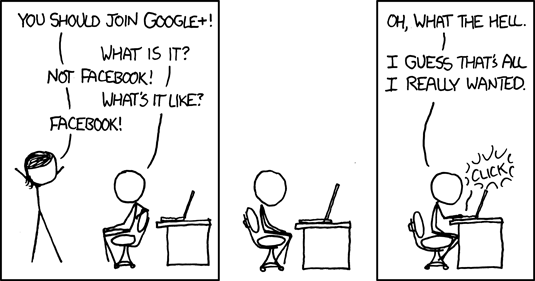
Cartoon is by the wonderful Randall Munroe, posted at his site xkcd and used under a Creative Commons license. Check out his book What If? in which he answers absurd hypothetical questions with real science.

1. Instagram and WhatsApp are both owned by Facebook.

Selling Your Personal Data Is Their Business

Grid

You probably noticed that Facebook was in the headlines again this week.

Social media, TV pundits, and politicians were outraged over high profile investigative reports in the New York Times and the Guardian claiming that personal information on 50 million Facebook users had been harvested by a researcher in 2014 and used to create targeted political ads for the trump campaign.

The details, of course, are far more complicated.1

For one thing, too many reports are calling what happened a “data breach”, often comparing it in some way to the Experian story from last year. But the term breach implies that someone outside of Facebook, in this case a researcher for the UK-based data analysis company Cambridge Analytica, broke in and stole the information.

In fact, the researcher followed Facebook’s rules and only collected information from something like 270,000 users, all of whom consented to the process. Then, thanks to the Facebook terms of service and API2 that applied in 2014, he was also able to harvest data from all of their friends, which brings us to the 50 million number most often quoted.

So, rather than having personal data stolen, Facebook gave it away. Or more likely, sold it.

Because that is their business model. It’s why the company has a market cap of around half a trillion dollars and CEO Zuckerberg has a net worth north of $60 billion.3

Facebook is very successful at collecting data from it’s more than two billion active members and then selling it to advertisers. Cambridge Analytica was one more advertiser and it didn’t matter that their ads were misleading and dishonest (at best). As long as the funds transfer went through.

Whatever you call this particular abuse of member data, it’s only the latest in a long string of arrogant and clueless decision the company has made over it’s short history. And, even with new privacy laws in Europe and Congress critters fighting over the opportunity to hold hearings, it probably won’t be the last.

And this is as good a time as any to again point out two facts about Facebook that anyone with an account should remember (but probably doesn’t):

1. Facebook is a multinational corporation not a community. Communities are built by people and, while it’s possible to create one using an online platform, the company itself is not going to make it happen.

2. Facebook membership is free. Which means you are not the company’s customer; you are the product they sell to advertisers. Monetizing your content and data is their first, maybe their only, concern.


I’m not sure the image has anything to do with this story.

1. In addition to the two articles linked above (the Times piece is probably a little better), Wired has done some of the best analysis of this story. This piece is a good place to begin.

2. API is application programming interface, the rules established by tech companies that allow outside code to communicate with their systems. In most cases, companies like Facebook provide very specific instructions as to what can be done with APIs.

3. Both took a big hit on Monday when Facebook’s stock dropped hard after investors spent the weekend digesting the Times and Guardian reports from Friday.