Seth Godin is a popular writer and speaker, well known for his work around marketing and organization. He also occasionally offers ideas around education.1 Probably his best known work in that area is the extended essay Stop Stealing Dreams and the TEDx talk on which it is based.2
In addition to writing a daily blog, Godin also does a weekly podcast called Akimbo, and in a recent episode he offered some thoughts about the educational establishment related to the recent college entrance cheating scandal that featured a few members of the rich and semi-famous.3
At the opening of the podcast, he makes this observation:
Management and leadership are not the same thing.
Management is done with power and authority, compelling others to do what we need them to do, when we need them to do it. Leadership, on the other hand, always involves voluntary compliance. It always involves people eagerly following the leader.
And the same dichotomy is true about learning and education.
Education is often done to us, it is mandatory, people show up and say “you will learn this and there will be a test”.
That’s different from learning. Learning is a process we choose to go through.
That idea of learning not being the same as education is one that has been stuck in my head for many years. And it’s not much of a stretch to modify Godin’s statement into this corollary: learning is not the same as teaching.
Teaching, at least in it’s popular interpretation, is also something done to students. Ask someone who’s not part of the profession what a “teacher” does and you’ll probably get a lot of verbs related to the transfer of information from an adult to kids. Someone who lectures, gives tests, and in general runs a space called “classroom”.
Learning, on the other hand, may or may not occur as the result of teaching. In a formal school setting, students are usually offered some incentive to retain certain information and skills for a relatively short period of time, although much of that is likely to disappear over the longer term. Maybe even between the spring tests and the beginning of the new school year.
Over a long career in and around public schools, I’ve heard more than a few colleagues say something to the effect of “I taught them, they just didn’t learn it” about their students.
This also ties back to some previous rants about personalized learning. Those systems seem to be more about teaching – the transmission of information to the subject for them to retain at least long enough to pass an assessment – than about learning. The goal of the artificially intelligent algorithms embedded in the software is to adapt the flow of data to the student’s ability to respond to it.
Is that “learning”? Maybe it’s one definition. Certainly it’s a process that produces a statistical score for classifying the learner.
In the end, however, genuine learning really only involves interests and topics that have some personal meaning or consequence for the learner. And that’s equally true for a high school freshman as it is for an adult of any age.
So, why do we persist in “teaching” instead of enabling “learning”?
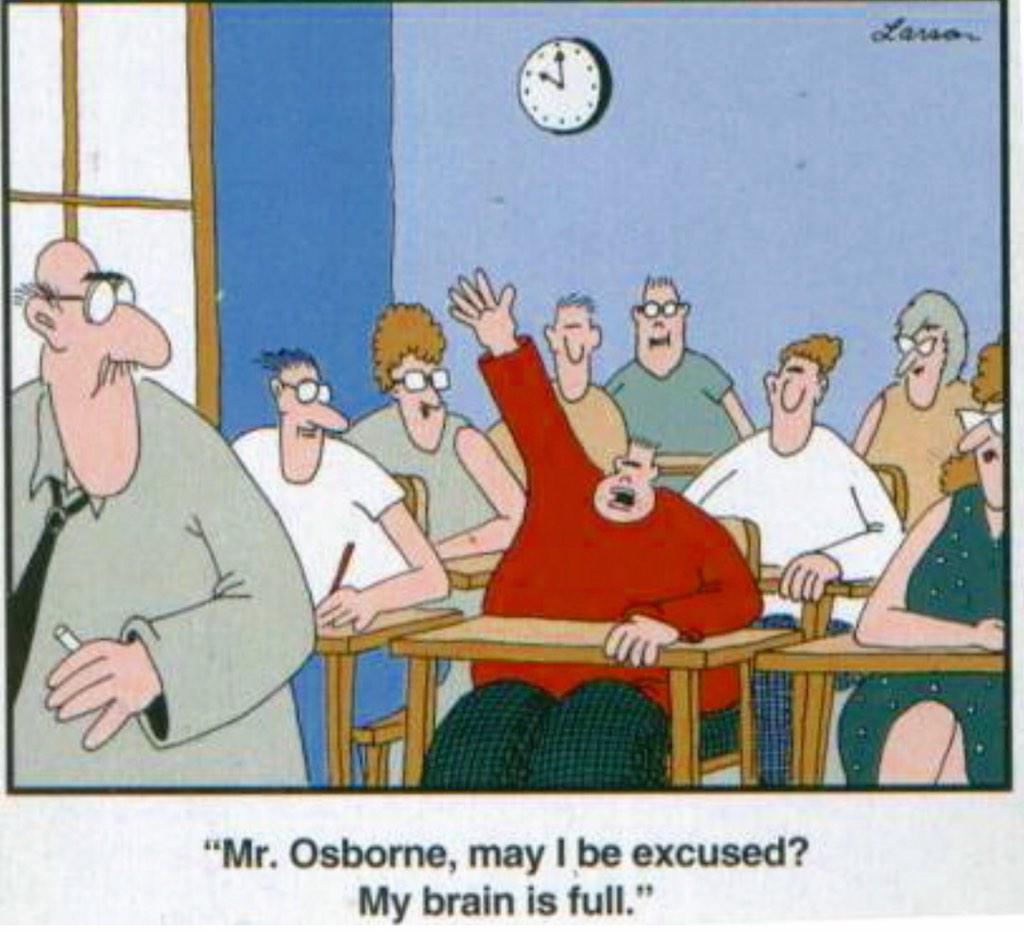
The image at the top is, of course, a classic cartoon from Gary Larson’s Far Side. I’m very likely violating copyright by using it, which is why I’m embedding it from someone else’s copyright violation. :-)
1. Don’t hold me to this, but I think I read somewhere that one or both of his parents were teachers. Which doesn’t make anyone an education “expert” but can add to their understanding of the profession from that particular time.
2. The talk is worth your time to watch. In the essay, I think he misses the mark as often as he hits it but his ideas about the American educational structure are still interesting.
3. And lost me in the process, as he sometimes does with other Akimbo episodes. Overall, however, I look forward to his weekly audio essays.