You Just Think You Own That Playlist

Screen Shot 2022 02 04 at 12 25 04 PM

Disregarding the politics involved, all the stories about artists pulling their recordings from Spotify had me thinking again about the way people consume music these days.

I’m old enough now that I’ve paid for The Beatles’ Abbey Road album at least four times. In college on vinyl, later on cassette tape, still later on CD, and more recently as a digital file.1 While the record and tape are long gone, I still have the digital file. And the CD is around here somewhere.

Continue reading

Pandemic Grades

Education reporting in The Washington Post is very often tone deaf (see also almost everything from Jay Mathews). It has been especially so during the pandemic.

A recent case in point is an article based on statistics from the overly-large school district with the blaring headline “Failing grades spike in Virginia’s largest school system as online learning gap emerges nationwide”. A similar story a week later declares “Failing grades double and triple — some rising sixfold — amid pandemic learning1, followed today by yet another article about failing grades in another Northern Virginia district.

Continue reading

Bad Commentary

Freedom of Blabber

Returning to the topic of reporting on COVID-19, coverage in The Washington Post has been actually pretty good over the past eight months. Not perfect (leaning too much on the political angle), but certainly a whole lot better than the information provided by television.

One area in which they have fallen short is in writing about the impact of the pandemic on education. Their reporters jump all over a story when the conflict is pretty easy to explain, but rarely go deeper into how the crisis could affect kids, families, teachers, and the community.

Continue reading

Free Comes With a Cost

IMG_2161

This article, with the provocative title Google’s got our kids, is about a year old, but the message is still one that every educator needs to understand. Especially if you’ve turned your classroom over to Google’s Classroom.

The author, a teacher who uses Google products with her students, makes the point that, although GSuite for Education and their other free or super-cheap products can be beneficial to schools and teachers, we also need to remember that the company has motives that are different from “normal” education vendors.

Unlike textbook publishers, Google has a “very strong interest not only in training the workforce of the future in G Suite, but also in forming positive and powerful brand associations in the minds of its littlest consumers”. Most of those kids sitting in front of a Chromebook running Google’s browser are too young to understand brand marketing.

Google’s “Be Internet Awesome” curriculum is another great example of the company selling itself to kids, specifically delivering the “message that Google is a trustworthy arbiter of online safety and privacy”.

The irony of a curriculum that teaches kids how to safeguard their privacy online yet is produced by a company known for its less-than-transparent use of personal data is a little on the nose, but the explicit lessons in Be Internet Awesome are too basic to be objectionable.

Pragmatic as the content is, it also transmits implicit lessons about the Google brand, whose brand colors, icons, and font are slathered over everything from student handouts to classroom posters to, for some reason, paper doll patterns for making your very own Internaut.

I doubt the students, or most of their teachers, get the irony.

In the end, the author admits that Google provides some useful tools, and that even the Be Internet Awesome curriculum “speaks to a real need schools have to prepare students for life in a digital world”.

However, we must understand that that these “free” resources still come with a cost.

The issue isn’t that Google has nothing of value to offer schools — clearly, it has — but rather at what price are we buying it. If it’s too steep we might want to recall lessons from our own educations, not about how to be savvy, polished consumers of technology, but about how to be citizens.


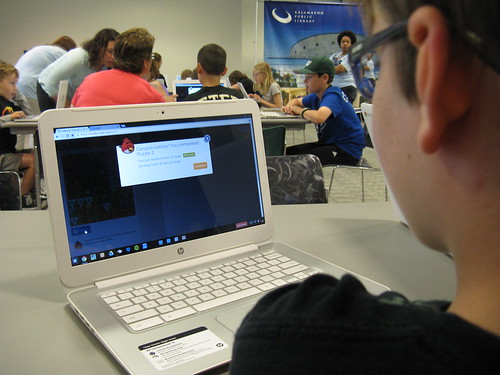
The image is from the Kalamazoo Public Library Flickr account, and is used under a Creative Commons License. Look closely at the screen. The student is viewing a message from a coding activity that incorporates characters from the game Angry Birds. Another example of brand marketing in a “free” educational product.

More About Alexa and Its AI Siblings

Following up on my previous rant about Alexa in the classroom, two good, related articles from Wired on the subject of artificial intelligence that are worth your time to read.

In one the writer highlights sections of reports to regulators from both Alphabet (Google’s parent) and Microsoft that warn of possible “risk factors” in future products.

From Alphabet:

New products and services, including those that incorporate or utilize artificial intelligence and machine learning, can raise new or exacerbate existing ethical, technological, legal, and other challenges, which may negatively affect our brands and demand for our products and services and adversely affect our revenues and operating results.

Microsoft was more specific:

AI algorithms may be flawed. Datasets may be insufficient or contain biased information. Inappropriate or controversial data practices by Microsoft or others could impair the acceptance of AI solutions. These deficiencies could undermine the decisions, predictions, or analysis AI applications produce, subjecting us to competitive harm, legal liability, and brand or reputational harm.

On the other hand, Amazon, in a report to stockholders, is more worried about governments regulating their products than they are about Alexa activating Skynet at sometime in the future.

The other post is a long excerpt from a book being published this month called “Talk to Me: How Voice Computing Will Transform the Way We Live, Work, and Think”.

It covers some pieces of recent history in the development of artificially intelligent products and the difficulty of programming a machine to understand the many ways that humans communicate.

I’m undecided about reading the whole book, but this part of it is worth 15 minutes.


The image is the user interface of HAL, the malfunctioning artificial intelligence from the 1968 film “2001: A Space Odyssey”. It also links to an interesting New York Times story of how the sound of HAL was created.